Densely Connected Convolutional Networks
原文地址:Densely Connected Convolutional Networks
摘要
Recent work has shown that convolutional networks can be substantially deeper, more accurate, and efficient to train if they contain shorter connections between layers close to the input and those close to the output. In this paper, we embrace this observation and introduce the Dense Convolutional Network (DenseNet), which connects each layer to every other layer in a feed-forward fashion. Whereas traditional convolutional networks with
layers have connections—one between each layer and its subsequent layer—our network has direct connections. For each layer, the feature-maps of all preceding layers are used as inputs, and its own feature-maps are used as inputs into all subsequent layers. DenseNets have several compelling advantages: they alleviate the vanishing-gradient problem, strengthen feature propagation, encourage feature reuse, and substantially reduce the number of parameters. We evaluate our proposed architecture on four highly competitive object recognition benchmark tasks (CIFAR-10, CIFAR-100, SVHN, and ImageNet). DenseNets obtain significant improvements over the state-of-the-art on most of them, whilst requiring less computation to achieve high performance. Code and pre-trained models are available at https://github.com/liuzhuang13/DenseNet.
最近的研究表明,如果卷积网络在靠近输入端的层和靠近输出端的层之间包含短连接,那么卷积网络可以更深、更准确、更有效地进行训练。在本文中,我们接受了这一观察,并介绍了密集卷积网络(DenseNet),它以前馈方式将每层连接到后续每一层。传统的卷积网络有
DenseNet
DenseNet(Dense Convolutional Network)通过连接(concatenating)不同层输出的方式,将之前所有层的输出都作为当前层的输入。对于第DenseNet共有
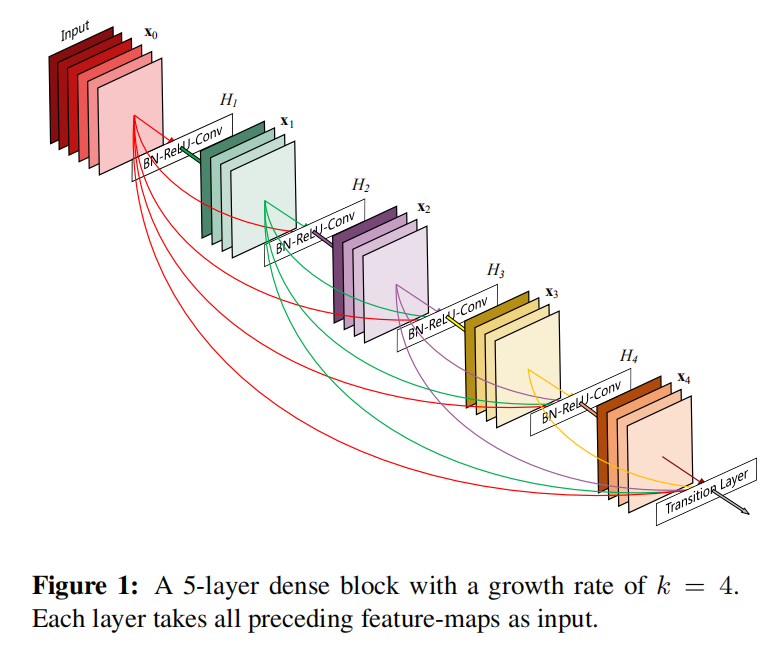
ResNet vs. DenseNet
假定输入图像
对于ResNet而言,其输出等于
对于DenseNet而言,其输出等于
其中
复合函数
3个连续执行的操作组成:
- 批量处理(
BN) - 激活函数(
ReLU) - 卷积操作(
Conv)
dense block/transition layer
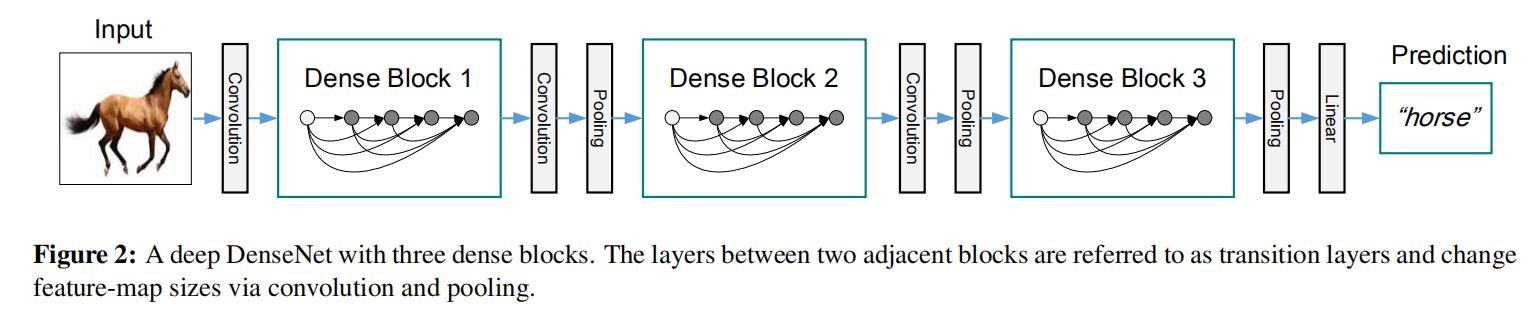
DenseNet由多个dense block和transition layer组成。在dense block中执行密集连接操作,在transition layer中执行特征图减半操作。其中transition层由以下操作组成:
- 批量处理(
BN) 卷积操作 平均池化操作
Growth rate
假定每个函数growth rate of the network)
bottleneck layer
论文将bottleneck layer),其BN-ReLU-Conv(1x1)-BN-ReLU-Conv(3x3),称这个版本模型为DenseNet-B
Compression
除了在Bottleneck Block中控制transition layer来减少特征图数目。假定一个dense block输出transition layer计算后得到DenseNet-C,论文使用DenseNet-BC
实现细节
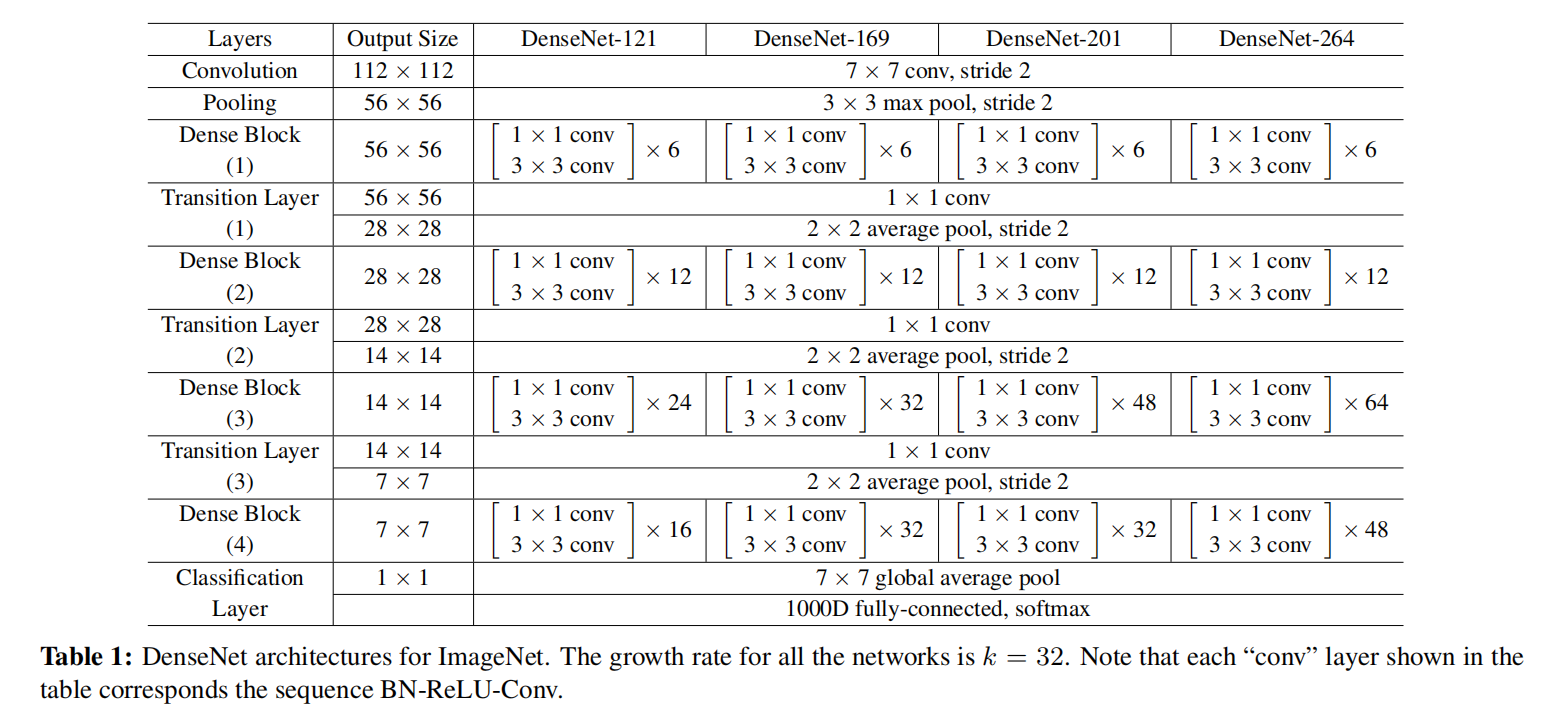
论文提出了两个版本的DenseNet:3个Dense Block或者4个Dense Block。其4个Dense Block的实现细节如下:
- 输入大小为
- 第一个卷积层使用
个滤波器,大小为 ,步长为
数据集
分别使用了CIFAR-10/100、SVHN以及ImageNet进行测试
CIFAR
大小彩色图像 CIFAR-10(C10)包含10类,CIFAR-100(C100)包含100类5万张训练图像,1万张测试图像
SVHN
街景门牌号码数据集(The Street View House Numbers DataSet)
大小彩色图像 73257张训练集、26032张测试集以及531131张图片用于额外训练
ImageNet
ILSVRC 2012分类数据集
120万张训练图片5万张验证图片- 共
1000类
训练
训练参数
对于CIFAR和SVHN数据集
- 批量大小:
64 - 训练次数:
300(CIFAR)和40(SVHN) - 初始学习率
0.1,迭代50%以及75%次后除以10
对于ImageNet
- 批量大小:
256 - 训练次数:
90 - 初始学习率
0.1,迭代30以及60次后除以10
其他训练参数如下:
- 权重衰减:
1e-4 Nesterov动量:0.9
训练结果
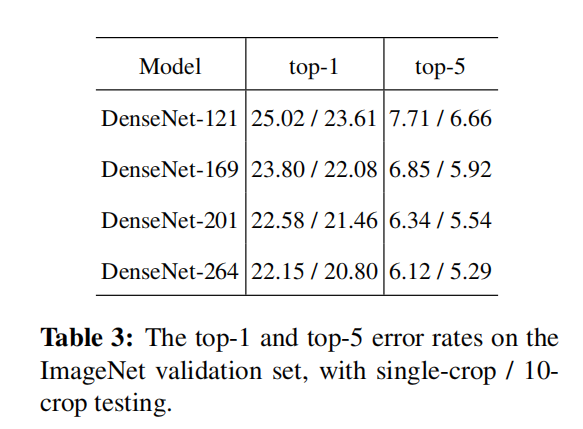
比较不同深度的DenseNet模型Top-1和Top-5误差率,如下表所示
比较各个模型基于不同参数数目/flops以及top-1误差率的结果,如下表所示
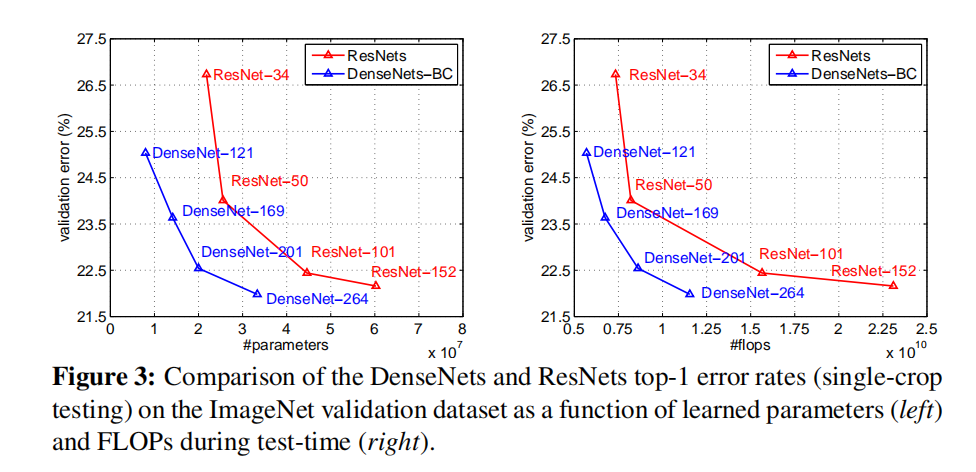
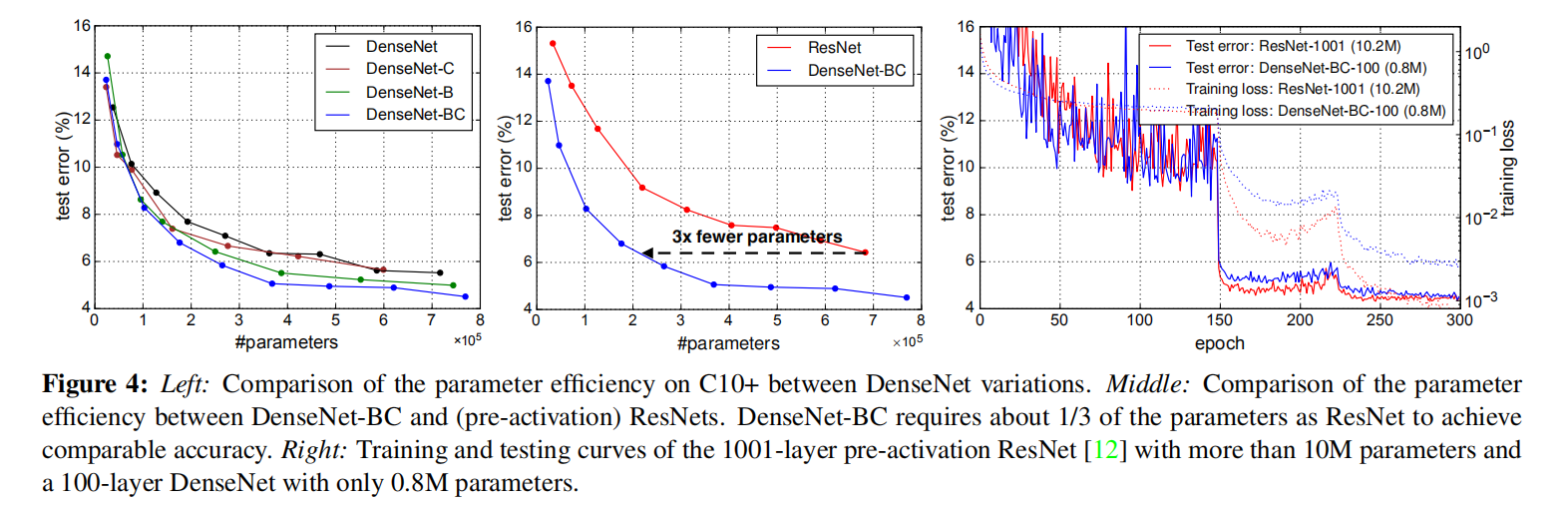
DenseNet通过Dense Block和Transition Layer,相比于ResNet,使用更少的参数数目就能够实现相似的检测精度。实验结果如下表所示
小结
自定义了DenseNet实现,参考zjZSTU/ResNet
各模型大小及Flops如下:
1 | densenet_121: 5.731 GFlops - 30.437 MB |